My first night out with binoculars: what you can actually see (and what you can't)
No telescope, no budget, one old pair of binoculars and a Kolkata terrace with a very annoying streetlight.
Neel Chatterjee12th Sample
9 Oct 2026 · 5 min read
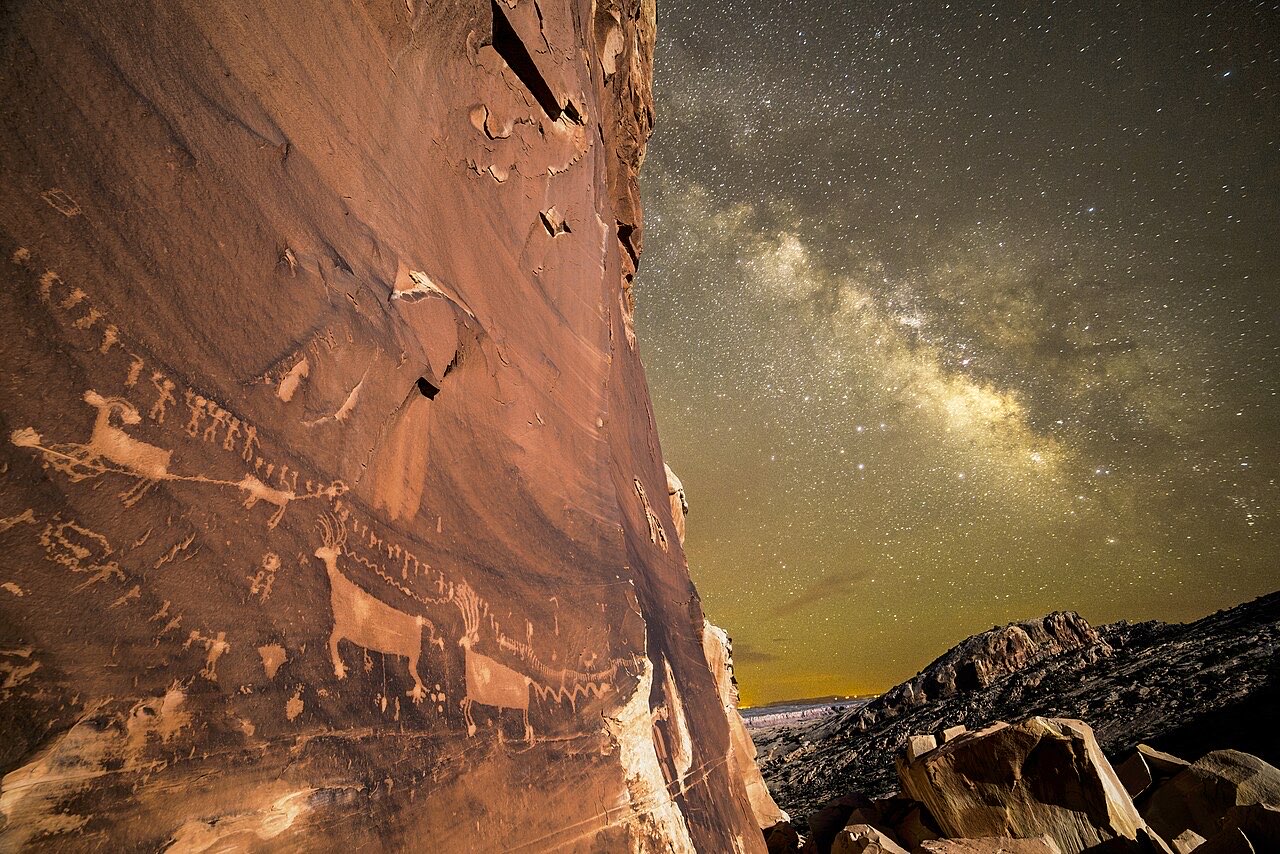
Photo: Marc Toso, AncientSkys Photography · CC BY-SA 4.0 · via Wikimedia Commons
I have wanted a telescope since I was ten. I have also wanted a lot of other things, and telescopes cost real money, so the wish sat on a list for six years. Then, a week before Pujo, my dad was cleaning out a cupboard and pulled out his old binoculars. 7x50, heavy as a brick, in a leather case that smelled like a 1990s holiday. "Take, take, they're just lying here," he said. The left lens cap is gone forever. That's how my astronomy actually started: a Kolkata terrace, a dead lens cap, and a lot of confidence.
This is what I learned in the first few nights. Mostly it's about what binoculars can and can't do, because everything I read before made them sound either useless or magical, and they're neither.
Decoding the numbers
Every pair has two numbers printed on it. Mine says 7x50. The first is magnification: things look 7 times closer. The second is the diameter of the front lens in millimetres. For stargazing the second number matters more than you'd think, because stars are faint and what you really need is to collect light. A 50 mm lens collects far more light than your eye's pupil, which opens to something like 6 to 7 mm in the dark.
Divide the two numbers and you get the exit pupil: mm. That's the width of the beam of light leaving the eyepiece, and it's close to what a young eye can open to at night, so almost none of the light is wasted. A 10x50 pair would give 5 mm, a bit narrower, with more zoom but also more shake. I'm staying with what I have.
The other thing binoculars give you is a wide field of view, so you can actually find things. A telescope is like looking through a straw, and finding anything in it at the start is miserable.
Night 1: the Moon
Do not start with the full moon. I did, and it was a glaring white plate. The good stuff is along the terminator, the line between day and night on the Moon. There the sunlight comes in at a low angle, every crater wall throws a long shadow, and the surface suddenly has depth. A few nights after new moon, the lit edge looked carved. I could see the big dark flat patches (the maria, which are old lava plains and have nothing to do with water, despite the name meaning "seas") and individual craters with raised rims. Honestly that alone was worth climbing the stairs.
Night 3: Jupiter's moons
When Jupiter was up, finding it was easy: the brightest "star" in that part of the sky, and it twinkles less than the stars around it. (Planets are tiny discs, so the atmosphere's wobble averages out. Stars are points, so they flicker.) Through the binoculars, if I held steady, there were small dots lined up on either side of it. Three on a good night, one on a bad night. These are the big moons Galileo spotted in 1610 with a much worse telescope: Io, Europa, Ganymede and Callisto. They sit in a line because we see their orbits nearly edge-on, and they shuffle positions night to night. I drew them in my notebook for a week. It's the most fun I've ever had with a pen.
What you will not see: Saturn's rings. In 7x, Saturn is a yellowish blob that looks slightly oval, and that's it. For the rings you need a telescope giving roughly 30 to 50x.
Night 5: a cluster and a smudge
The Pleiades (M45) are visible to the naked eye as a tiny fuzzy dipper, six or seven stars if your eyes are good. In binoculars it explodes into dozens of blue-white stars. It's a young open cluster, around 440 light years away.
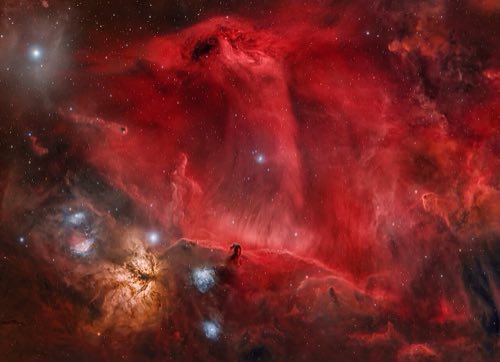
Then I waited for Orion to clear the buildings, which in October means staying up. Below the three belt stars there's a short vertical line of fainter ones, the "sword". The middle "star" of the sword looks fuzzy even to the naked eye. In binoculars it's a grey, slightly curdled cloud. That's the Orion Nebula, roughly 1,300 light years away, a cloud of gas and dust where new stars are forming right now. I stood on a terrace in the middle of a city and looked at a stellar nursery. That's when I went completely quiet.
What I couldn't see: Andromeda
The Andromeda Galaxy is the farthest thing you can see without equipment, about 2.5 million light years away, which means the light reaching your eye left it before our species existed. From a dark site it's a long faint smear. From my terrace I saw absolutely nothing. Which brings me to the thing I'm still annoyed about.
Light pollution
Astronomers use the Bortle scale to rate how dark a sky is, from 1 (remote and perfect) to 9 (inner city). My terrace sits at the bad end. Skyglow doesn't dim the Moon or the bright planets much, but it kills faint, spread-out things like nebulae and galaxies, because it raises the brightness of the background sky. It's a contrast problem, not a brightness problem. There's also a streetlight right below our building; I now stand behind the water tank so it blocks the glare. Low tech, works.
Things that helped:
- Give your eyes at least 20 minutes in the dark. One glance at a phone screen and you lose it. A torch covered with red cellophane is fine.
- Lean on something. Elbows on the parapet, or lie back on a folding chair and rest the binoculars against your brow bones.
- Use a free sky-map app to find things, then put the phone away.
- October to February is far better than the monsoon months. The monsoon sky is just cloud.
- One planned trip to a dark place is worth ten terrace nights. I'm trying to convince my family to go to a village outside the city on a new moon weekend.
So: binoculars are not a telescope, but they're a very honest first instrument. I now know where Jupiter is, I can find Orion's sword without a map, and I have a notebook full of bad sketches. The telescope can wait. Maybe.
12 responses
Sign in to join the conversation.
[+][–]Arjun Nair12thSample· 10d ago
This is the post I wish I'd read before I wasted money on my first scope. 7x50 is honestly a great beginner setup, the wide field means you learn the sky properly instead of just chasing one object. Also the Moon's terminator tip is the thing nobody tells you. Full moon through any instrument is basically a flashlight to the face.
[+][–]Rohan Sharma11thSample· 10d ago
bro your dad's cupboard has better gear than my entire inventory 😭 the dead lens cap is sending me
[+][–]Neel Chatterjee12thSample· 10d agoAuthor
It had a lens cap once. Its whereabouts are an unsolved family mystery.
[+][–]Lakshmi TripathiDropperSample· 10d ago
I only use binoculars for birds (8x42), I never thought of pointing them upward. Tried it last night from our terrace. Three tiny dots in a row next to a very bright thing that was not a star. I stood there ten minutes and didn't say anything to anyone. Thank you for this. One problem though, my arms were shaking after a minute, is there a trick?
[+][–]Neel Chatterjee12thSample· 10d agoAuthor
Yes. Don't hold them free in the air. Rest your elbows on the parapet or a wall, or sit and brace your elbows on your knees. The best one for me is lying back on a folding chair and resting the barrels on my brow bones, then it's your head that holds them, not your arms. Also breathe out slowly before you look, the shake drops a lot.
[+][–]Kabir Joshi11thSample· 10d ago
Question about colour. Every photo of the Orion Nebula is pink/red and you said grey. Are the photos edited or what?
[+][–]Neel Chatterjee12thSample· 10d agoAuthor
Not faked, just a different detector. In the dark our eyes switch to rod cells, which are very sensitive but basically colourblind. The colour cells (cones) need more light. A camera on a long exposure keeps collecting light for seconds or minutes, so it picks up the faint red glow from hydrogen gas that your eye can't register. Some people do report a faint grey-green tint in the nebula by eye, but nothing like the photos.
[+][–]Harsh Gupta12thSample· 10d ago
so my eyes are a camera with night mode permanently off. bhai even my phone does this better than me
[+][–]Rohan Sharma11thSample· 10d ago
wait so can I see saturn's rings with these or nah
[+][–]Neel Chatterjee12thSample· 9d agoAuthor
Nah, not in 7x. You'll see Saturn as an oddly oval yellow dot. The rings need a telescope with a lot more magnification.
[+][–]Sara Fernandes11thSample· 9d ago
Come to Goa in the dry season. Go away from the beach shacks, to some village road with no lights, and the sky is unreal. We camped near a paddy field once and I saw the Milky Way as an actual band with my own eyes for the first time. Bring a mat, lie down, and forget the binoculars for ten minutes.
[+][–]Tushar PawarDropperSample· 9d ago
Tried my phone against the binocular eyepiece after reading this. Blurry Moon, but a Moon. I'm now thinking about designing a 3D-printed phone holder for it. Will report back if it doesn't fall apart.