How do we know how far a star is? Hold up your thumb
The same trick your two eyes use to judge depth is the bottom rung of the ladder that measures the universe.
Arjun Nair12th Sample
15 Sept 2026 · 5 min read
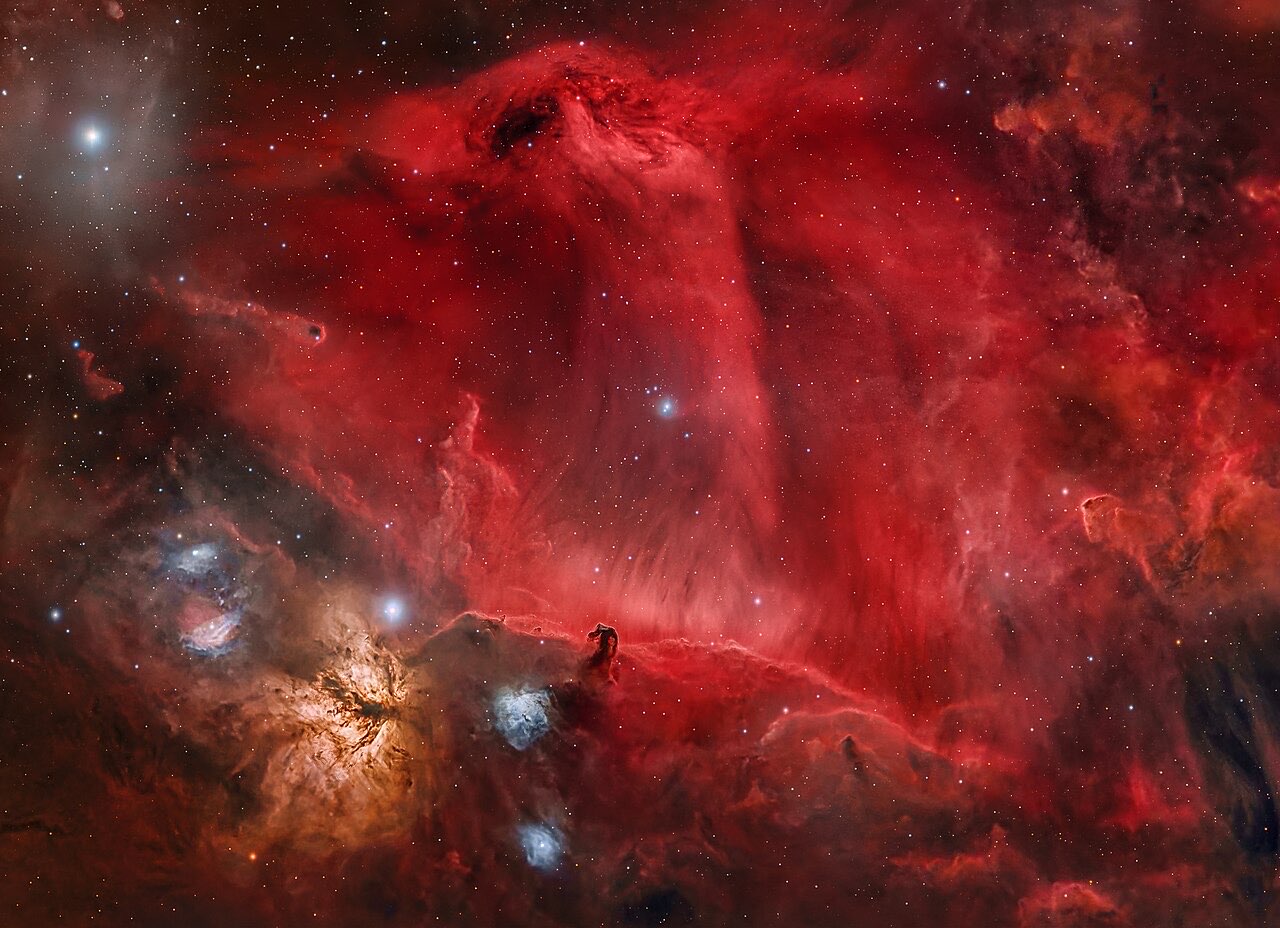
Photo: Gianni.lacroce · CC0 · via Wikimedia Commons
Hold your thumb out at arm's length. Close your left eye. Now swap: open the left, close the right. Your thumb jumps sideways against the background. Bring the thumb closer to your nose and the jump gets bigger. That jump is parallax, and it's the first method humans ever used to measure the distance to a star. It sounds too simple to be real science. It's the same trick, just with a much, much bigger baseline.
From two eyes to Earth's orbit
Your eyes are about 6 cm apart. That separation is your baseline. For nearby objects, the two views differ enough that your brain can work out depth. For a mountain 10 km away the difference is invisible, which is why depth perception gives up beyond some tens of metres.
For stars we need a far longer baseline, and Earth supplies one. In January we view a nearby star from one side of Earth's orbit; six months later from the opposite side. The two positions are AU apart, where 1 AU (the Earth-Sun distance) is about km. The nearby star seems to shift slightly against the far-away stars behind it. Half of that total shift is called the parallax angle .
The geometry is a very thin right triangle: one side is 1 AU, the angle at the star is , and the long side is the distance :
I love that shows up in real life and not just in a chapter on approximations.
The parsec is a definition that makes this painless
Angles in the sky are measured in degrees, arcminutes and arcseconds: 1 degree = 60 arcminutes = 3600 arcseconds. One arcsecond is absurdly small. A 1 cm coin would subtend about one arcsecond if you looked at it from 2 km away.
Put arcsecond rad into the formula:
That distance is defined as 1 parsec (the name is short for "parallax of one arcsecond"). One light year is km, so 1 parsec is about 3.26 light years. And now the payoff, with in arcseconds:
No constants to remember. That's the entire reason the unit exists.
Worked example
Proxima Centauri, the nearest star after the Sun, has a parallax of about 0.77 arcsec. So pc, which is about 4.2 light years. A star with would sit at pc, about 65 light years.
Notice that no star has a parallax of even 1 arcsecond, because the nearest one is already 1.3 pc away. These shifts are tiny. The idea was understood for ages, but the first successful measurement only came in 1838, because it needed telescopes and patience that earlier astronomers didn't have.
Why it stops working
From the ground the atmosphere blurs everything, so ground-based parallax is only good for stars up to roughly a hundred parsecs away. Space fixes that. A satellite called Hipparcos measured about a hundred thousand stars in the 1990s. Its successor, Gaia, has done it for well over a billion stars and reaches out thousands of parsecs. The Milky Way's disc is about 30,000 parsecs across, so we can now map a big chunk of our own galaxy this way. Other galaxies are far too distant for parallax.
The ladder
So astronomers use a cosmic distance ladder: each rung is calibrated using the one below it.
| Rung | Method | Idea |
|---|---|---|
| 1 | Parallax | Pure geometry, nearby stars |
| 2 | Cepheid variables | Pulsation period tells you true brightness |
| 3 | Type Ia supernovae | Explosions of roughly standard brightness, visible across billions of light years |
| 4 | Redshift / Hubble's law | Expansion speed of far galaxies |
Rung 2 is my favourite. In 1912 Henrietta Leavitt noticed that among variable stars in the Small Magellanic Cloud (all at roughly the same distance from us), the ones that pulsed more slowly were intrinsically brighter. So if you measure a Cepheid's period, you know its true luminosity . Measure how bright it looks, , and the inverse-square law gives the distance:
And how do we calibrate the true luminosity of Cepheids in the first place? Using the few that are close enough to have a measured parallax. That's why this stuff matters to me: the thumb trick is the bottom rung. If it's wrong, everything above it is wrong.
Try it with your own thumb
You can estimate the distance to something far away using nothing but your hand. Hold your thumb at arm's length. Your arm is roughly ten times your eye separation, so when you swap eyes, the thumb's apparent jump at the distance of your target is about one tenth of the distance to that target. So: line the thumb up with a faraway object (say a bus), swap eyes, and estimate how far the thumb jumped measured against things at that distance. If it jumped across about three metres worth of background, the object is around 30 m away. Multiply the jump by ten. It's rough, but it works, and the similar-triangles reasoning is the same as the star version.
Next time I'm bored in a bus, I'm measuring things with my thumb. You'll find me weird. I accept this.
12 responses
Sign in to join the conversation.
[+][–]Rohan Sharma11thSample· 1mo ago
ok the thumb trick just worked and I feel like a genius. closed my left eye and my thumb jumped like half the wall 😭 "parallax" sounds like a spell
[+][–]Arjun Nair12thSample· 1mo agoAuthor
Welcome to astronomy. Now do the ranging version at the end and tell me if the bus-distance guess came close.
[+][–]Harsh Gupta12thSample· 1mo ago
so the parallax angle is the full shift between January and July right? that's what my notes say
[+][–]Arjun Nair12thSample· 1mo agoAuthor
Half of it. The parallax angle is defined using 1 AU as the baseline, meaning the angle at the star between the Sun and Earth. The full shift between your January and July observations is 2p. Easy factor-of-two mistake, and I've made it too.
[+][–]Harsh Gupta12thSample· 1mo ago
factor of 2 error, my entire personality. thanks, fixing my notes
[+][–]Kabir Joshi11thSample· 1mo ago
why can't we just use two telescopes very far apart on Earth, like India and Australia, instead of waiting 6 months?
[+][–]Arjun Nair12thSample· 1mo agoAuthor
You can, and people did, but only for close things. The baseline can be at most Earth's diameter, about 12,700 km. Earth's orbit gives 2 AU, about km, which is over twenty thousand times longer. For the Moon the parallax from two places on Earth is large (around a degree), which is how its distance was first measured. For stars it would be far too small to detect.
[+][–]Meera Patel11thSample· 1mo ago
One thing worth adding about Leavitt's discovery: she used stars in the Small Magellanic Cloud precisely because they're all about the same distance from us. So differences in how bright they looked had to be differences in how bright they really were. That's what made the period-luminosity link visible. I found that part genuinely clever.
[+][–]Arjun Nair12thSample· 1mo agoAuthor
Yes, thank you, I should have said that. The "all at the same distance" part is the whole trick.
[+][–]Ishaan Bose11thSample· 1mo ago
no offense but the formula part lost me. the thumb thing, the parsec thing and the coin from 2 km I got. why do astronomers need three different units (AU, light year, parsec) lol
[+][–]Arjun Nair12thSample· 1mo agoAuthor
Each one fits a scale. AU for the solar system, light year because it's easy to picture, parsec because it comes straight out of the parallax method, so with no conversion. Professionals mostly use parsecs, popular articles mostly use light years.
[+][–]Tushar PawarDropperSample· 1mo ago
"If the bottom rung is wrong, the universe is wrong" is such a good line. Funny thing is, there's an ongoing disagreement between ladder-based measurements of the expansion rate and the ones from the early-universe background radiation. People are still arguing about whether it's a measurement issue or new physics.